
Refractory Library
Insulating bricks, castables and mortars
Grades with density, strength and temperature data. Selected, checked and supplied from China by GZ Visions, Shanghai.
Quick answer
GZ Visions supplies insulating fireclay bricks with a bulk density of 0.7 to 1.1 g/cm³ and a thermal conductivity of 0.21 to 0.35 W/(m·K), six castables for use up to 1650 °C, and five mortars: fireclay, mullite, silicon carbide and insulating. Every GZ grade is listed with its limits.
Insulation
Insulating bricks and granules
Insulating bricks have a low bulk density and a low thermal conductivity. They sit in the insulation layer of the furnace body behind the dense working lining, where they cut heat loss and keep the shell cooler. Choose the grade by its reheat test temperature, the highest temperature at which its liner change after reheating stays within 2%.
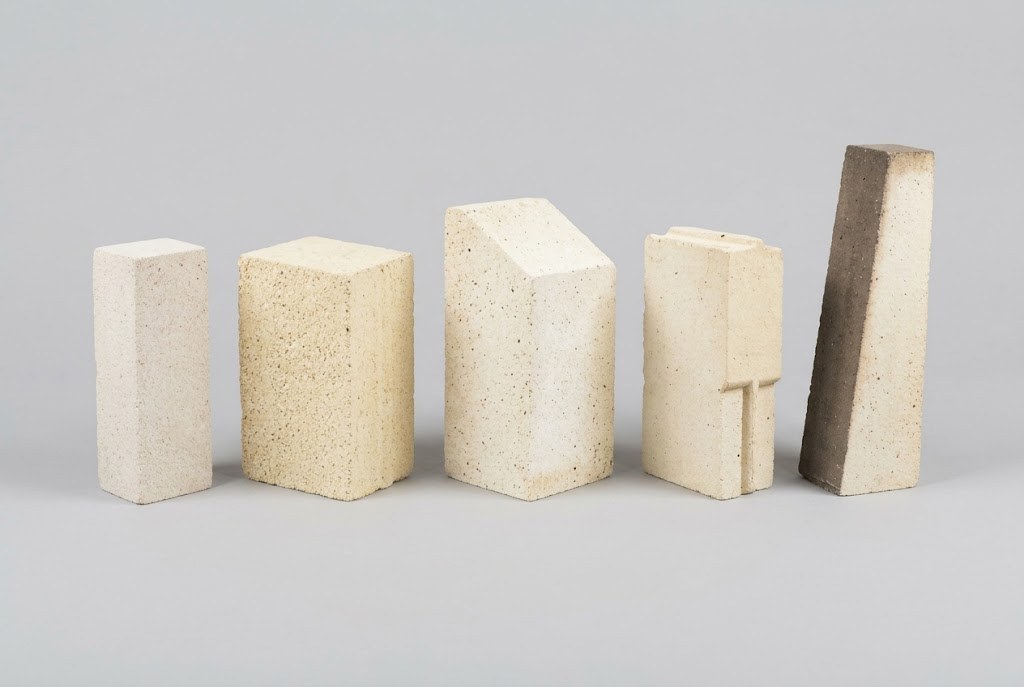
Insulating fireclay bricks and insulation granules
Bulk density in g/cm³ (maximum). Cold crushing strength (CCS) in MPa (minimum). Reheat test temperature: the highest temperature at which the liner change after reheating stays within 2%, in °C. Thermal conductivity in W/(m·K), mean temperature 350 ± 10 °C (maximum). All used as the insulation layer of the furnace body.
| GZ grade | Type | Density | CCS | Reheat test temperature | Thermal conductivity |
|---|---|---|---|---|---|
| GZ IB-01 | Insulating fireclay brick | 0.7 | 3.0 | 1100 | 0.23 |
| GZ IB-02 | Insulating fireclay brick | 0.7 | 3.0 | 1000 | 0.21 |
| GZ IB-03 | Insulating fireclay brick | 1.1 | 6.0 | 1300 | 0.35 |
| GZ IG-01 | Insulation granules | 0.3 to 0.4 | - | 1000 | - |
Castables
Castables for cones, chutes and furnace bodies
A castable is poured or placed in the shape the lining needs. The fireclay and high alumina castables below are listed for the cone body of a coke dry quenching furnace, the super duty grade for the primary cyclone dust collector and the chute, the brown corundum plastic castable for the chute, and the two insulation castables for the furnace body.
How to read the tables: values are specification limits, not averages, and the temperature in brackets is the test temperature. A dash means the supplier lists no value for that cell.
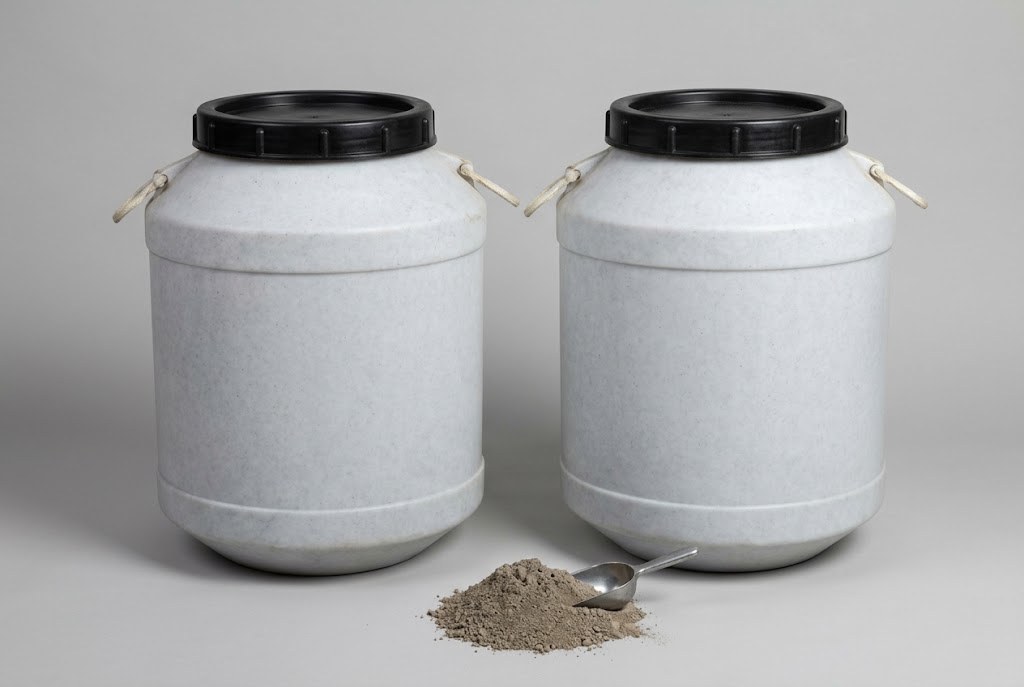
Castables
Al₂O₃ in % (minimum). Bulk density after firing in g/cm³ (minimum, the temperature is shown where listed). Liner change after heating in %. Modulus of rupture (MOR) in MPa (minimum), after drying and after heating. Refractoriness in °C (minimum). Thermal shock: cycles of 850 °C water cooling.
| GZ grade | Type | Fired or service temperature | Al₂O₃ | Density | Liner change | MOR after drying | MOR after heating | Other | Used in |
|---|---|---|---|---|---|---|---|---|---|
| GZ CA-01 | Fireclay castable | 1300 (fired) | 40 | 1.80 | -0.1 to +1.0 | 5.0 | 0.5 (1300 °C) | Expansion critical temperature 1300 °C; RUL 1120 °C | Cone body |
| GZ CA-02 | High alumina castable | 1400 (service) | 65 | 2.6 (1400 °C) | ±0.5 (1400 °C) | 9.0 (105 °C) | 1.5 (1400 °C) | - | Cone body |
| GZ CA-03 | Super duty high alumina castable | 1650 (service) | 65 | > 2.55 (1000 °C, 3 h); > 2.65 (1400 °C, 3 h) | -0.5 to +0.3 (1000 °C, 3 h); +0.5 (1400 °C, 3 h) | 20.0 (105 °C) | 15.0 (1000 °C, 3 h) | Abrasion resistance 15 | Primary cyclone dust collector and chute |
| GZ CA-04 | Insulation castable | 800 (fired) | - | 0.90 | -0.1 to +1.0 | 0.6 | 0.5 (800 °C) | Expansion critical temperature 800 °C | Furnace body |
| GZ CA-05 | Insulation castable | 1000 (fired) | - | 1.10 | -0.1 to +1.0 | 1.2 | 0.5 (1000 °C) | Expansion critical temperature 1000 °C | Furnace body |
| GZ CA-06 | Brown corundum plastic castable | - | - | 2.7 | -0.45 (1000 °C) | 9 (1000 °C) | 13 (1000 °C) | Refractoriness 1710 °C; thermal shock 30 cycles | Chute |
Mortars
Mortars for laying brick
Match the mortar to the brick it joins: fireclay mortar for fireclay brick, mullite mortar for mullite brick, silicon carbide mortar for mullite brick, and insulation mortar for insulating brick.
Mortars
Al₂O₃ and SiC in % (minimum), Fe₂O₃ in % (maximum). Refractoriness and refractoriness under load (0.2 MPa) in °C (minimum). Bending strength in MPa (minimum) after 24 h at the temperature shown. Grain size in mm (maximum).
| GZ grade | Type | Al₂O₃ | SiC | Fe₂O₃ | Refractoriness | RUL | Bending 110 °C | 400 °C | 600 °C | 800 °C | 1100 °C | Grain size | Used for |
|---|---|---|---|---|---|---|---|---|---|---|---|---|---|
| GZ MO-01 | Fireclay mortar | 40 | - | 1.3 | 1690 | 1350 | 4 | 5 | 5 | 5 | 5 | 2 | Laying fireclay brick |
| GZ MO-02 | Fireclay mortar | 48 | - | 1.3 | 1710 | 1350 | 4 | 5 | 5 | 5 | 5 | 2 | Laying fireclay brick |
| GZ MO-03 | Mullite mortar | 65 | - | - | 1730 | 1450 | 5 | 7 | 7 | 7 | 7 | 2 | Laying mullite brick |
| GZ MO-04 | Silicon carbide mortar | 40 | 30 | - | 1770 | 1500 | 5 | 7 | 7 | 7 | 9 | 1 | Laying mullite brick |
| GZ MO-05 | Insulation mortar | - | - | - | - | - | 0.2 | - | - | - | 0.1 | - | Laying insulating brick |
How to specify
What we need to match the right product
Send the furnace or vessel, the zone, the maximum working temperature, the contact (slag, metal, gas or abrasion) and the method: casting, gunning, ramming or laying. For mortars, send the brick family you are joining.
How we work
What GZ Visions does for your order
- 01We match the product to your furnace, your temperature and your drawing or list.
- 02We quote by item and by tonne, FOB China or delivered to your port.
- 03We check the order at the factory before it ships and can arrange third party testing at your request.
- 04One contract and one point of contact at GZ Visions.
- 05Languages: English, Turkish, Portuguese and German from Cengiz; Arabic, Spanish and Chinese through our team.
FAQ
Frequently Asked Questions
- What is the difference between an insulation castable and a dense castable?
- A dense castable is a working lining. An insulation castable has a much lower bulk density, 0.90 and 1.10 g/cm³ for our two insulation grades against 1.80 to 2.7 for the dense ones, and sits behind the working lining to cut heat loss.
- How do I choose a mortar?
- Match it to the brick it joins. GZ MO-01 and MO-02 are fireclay mortars, MO-03 is a mullite mortar, MO-04 is a silicon carbide mortar and MO-05 is an insulation mortar for insulating brick.
- How hot can the castables go?
- The fired or service temperatures listed run from 800 °C for the lightest insulation castable to 1650 °C for the super duty high alumina castable. Each grade shows its own test temperatures in the table.
- What do I send for a quote?
- Product, furnace, zone, working temperature, installation method, quantities in tonnes and destination port. A person from GZ Visions replies the same business day.
Request a quote
Send your drawing or list.
Furnace type, working temperature, quantities in tonnes and destination port. A person replies the same business day.